Lisboa
Capital and largest city of Portugal and home of Christiano Ronaldo, the world's best soccer player.
Population: 550,000 (approx)

****************************************************************************************
On the positive side, the young lady at Santa Apolinia Tourist Info Centre was really helpful in giving us all the information we needed about the integrated public transport system (Cassis), the trams, metro and YES the Hop-on Hop-off Double Decker tour bus around Lisbon. We took in all the sites and got a great orientation of the city picking out places we wanted to visit later. One of the first things you notice in the old City is the Mosaic footpaths which have been around since the beginning of the century. A description I read, and aptly describes them is "Grimy but Attractive". But for us - NOT so attractive when you have to step over and dodge doggy doo which no one seems to clean up. Just disgusting! (Someone should tell these folks about the high pressure hoses they use in Pamplona to clean the streets).
We were told about the Portuguese aristocracy of old times, but it begs the question – What went wrong? There are still signs of that nobility and certainly stores are filled with elegant clothing and jewellery, but what was more notable was the absolute poverty, homelessness and begging in the streets on a par with the poorest of countries we had travelled to so far. What surprised us even more, was when we took our usual “mystery tours” Metro train rides to the end of the line to the “burbs and a place called Amadora Este. In all our travels it was the quickest return train ride we’d had anywhere, anytime. It wasn’t until we got out of the subway and what we saw was a “shanty town” made up of scrap tin, cardboard, canvas and wood structures spread out over approx 2kms across a ridge beyond the station. We wouldn’t believe it if we hadn’t seen it for ourselves. Unbelievable!
Don't get us wrong, there were some really beautiful places in and around Lisbon, few and far between but they were there. One of those is the former Expo '98 area, now called Nations Park (Parque das Nações). Unlike the Brisbane Expo site, now Southbank, the area has not been abandoned or demolished but is used as a community area and waterfront markets, restaurants and the Oceanarium. The original stadium is still used as a venue for concerts and conventions and is hugely popular on weekends.
 The No. 28 Tram that goes into the old city area, a bit like the steep and windy streets of San Francisco, where Fado (far-doo) guitar music is played in cafes, restaurants and the like and we had the opportunity to listen to this haunting style of music over a lunch near the Castelo de Sao Jorge with a Fado Museum nearby.
Now that Tony has pretty much overcome his fear of heights one of the places to see in Lisbon was the Elevador de Santa Justa, a high metal structured elevator built in 1902. Info about Elevador de Santa Justa
After 6 days in Lisbon we were ready to move along, and in all the 6 days of roaming around the city and surrounds Christiano Ronaldo was nowhere to be seen. The closest we got was to a picture of him in a Rolex advert in the window of one of those shops still selling goods for the aristocrats and to the No 7 Ronaldo jerseys in the souvenir shops. Think we’ll pass on those.
Capital and largest city of Portugal and home of Christiano Ronaldo, the world's best soccer player.
Population: 550,000 (approx)

****************************************************************************************
By the time our overnight sleeper train arrived into San Sebastian bound for Lisbon at around 10.30pm we were ready to really hit the pillows reflecting on the Pamplona festivities. Actually the little double bunks we had were quite comfortable except that when the train would stop at a station through the night it felt like you would roll off the bed as the train braked. As part of the ticket we had a complimentary breakfast, but Tony's blog would probably cover the little 'greasy' croissants and strong coffee. Not a nice start as a healthy breakfast.
 |
| No. 28 Tram in Lisbon |
Our first glimpses getting into Lisbon were the vast rice paddies, factories and old run down houses, expressways, olive groves and vineyards on the journey in. Not sure what to think but we had an open mind knowing that Portugal was in economic stress and looking for a handout from the EU. Lisbon is set on the Rio Tejo (Tagus River) and has several main tributaries flowing into it, which explains the vast number of rice paddies. And with a large Port/Marina Lisbon is known for its variety of seafood especially "Sardinahs" which are char-grilled, and Cod which is preserved and dried with sea salt and reconstituted for use in seafood dishes. The cod doesn't smell particularly nice when it is left out in the open (unrefrigerated), but Tony assures me it is quite delicious when cooked up into a Portuguese traditional dish.
 |
| Praca do Comercio |
The main transit station, the historic Santa Apolinia was supposed to be a short walk from where we were staying however we decided to catch a cab instead. That was a mistake because even though I had the "Correct" address written down, showed the driver, we seemed to be taking an extraordinarily long time for "a short walk". The cabbie tried to make out that I had it wrong - NO. So he made a couple of extra Euros for the trip - one of the tourist traps we fell into and when you don't know the language it makes it a little hard to argue the toss.
But back to the subject of food we found a local supermarket called LIDL (pronounced LIDA), strangely it had the same colours and a similar logo to ALDI (an acronym of Lida ??). It even had the same floor layout as Aldi, and again we found that here too supermarkets sell groceries and alcohol under the one roof - and cheap too. To give you an idea we bought a pack of 5 bread rolls for around .35 cents, 1 and a half litre bottles of water for .19 cents. Sangria, wait for it ... 1 and half litres for 1.19 Euros. We also found that for a main meal you could buy fish, salad, chips, (all done Portuguese style) plus wine or beer for around 6 Euros.
On the positive side, the young lady at Santa Apolinia Tourist Info Centre was really helpful in giving us all the information we needed about the integrated public transport system (Cassis), the trams, metro and YES the Hop-on Hop-off Double Decker tour bus around Lisbon. We took in all the sites and got a great orientation of the city picking out places we wanted to visit later. One of the first things you notice in the old City is the Mosaic footpaths which have been around since the beginning of the century. A description I read, and aptly describes them is "Grimy but Attractive". But for us - NOT so attractive when you have to step over and dodge doggy doo which no one seems to clean up. Just disgusting! (Someone should tell these folks about the high pressure hoses they use in Pamplona to clean the streets).
 |
| Mosaic Footpaths |
And as we saw more of ‘charming’ Lisbon we were disappointed with the fact many historical sites, buildings and facades were left neglected or abandoned, and in need of some serious cleaning/sand blasting. Even in one of the most central plazas in the city, Praca de Figueira, where tourists flock by the thousands it disappointed us to see this beautiful building with the terracotta roof caving in. The building still looked partly occupied !!
We were told about the Portuguese aristocracy of old times, but it begs the question – What went wrong? There are still signs of that nobility and certainly stores are filled with elegant clothing and jewellery, but what was more notable was the absolute poverty, homelessness and begging in the streets on a par with the poorest of countries we had travelled to so far. What surprised us even more, was when we took our usual “mystery tours” Metro train rides to the end of the line to the “burbs and a place called Amadora Este. In all our travels it was the quickest return train ride we’d had anywhere, anytime. It wasn’t until we got out of the subway and what we saw was a “shanty town” made up of scrap tin, cardboard, canvas and wood structures spread out over approx 2kms across a ridge beyond the station. We wouldn’t believe it if we hadn’t seen it for ourselves. Unbelievable!
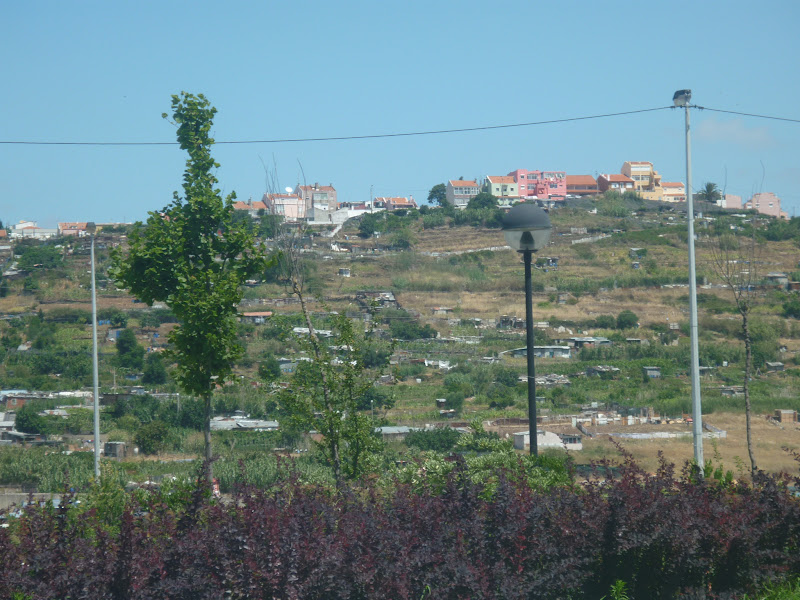 |
| Amadora Este |
Don't get us wrong, there were some really beautiful places in and around Lisbon, few and far between but they were there. One of those is the former Expo '98 area, now called Nations Park (Parque das Nações). Unlike the Brisbane Expo site, now Southbank, the area has not been abandoned or demolished but is used as a community area and waterfront markets, restaurants and the Oceanarium. The original stadium is still used as a venue for concerts and conventions and is hugely popular on weekends.
 The No. 28 Tram that goes into the old city area, a bit like the steep and windy streets of San Francisco, where Fado (far-doo) guitar music is played in cafes, restaurants and the like and we had the opportunity to listen to this haunting style of music over a lunch near the Castelo de Sao Jorge with a Fado Museum nearby.
  |
| Portuguese style Tiled houses and shops |
Now that Tony has pretty much overcome his fear of heights one of the places to see in Lisbon was the Elevador de Santa Justa, a high metal structured elevator built in 1902. Info about Elevador de Santa Justa
He was pretty chuffed with himself, smiling about his achievement. Being so high up and being relatively close to the Tagus River there was a fair breeze blowing that particular day. His smiling stopped when rubber matting blew over to expose some severe rust underfoot and there were still people coming to the top of the tower. This almost became another of the quickest return trips we had ever made in our travels.
 |
| Flooring on top of Elevador de Santa Justa |
There were other highlights too, such as:
 |
| Parque Eduardo VII |
 |
| Lisbon Funicular |
 |
| Jeronimos |
 |
| Bull Fight Arena |
Praca do Comercio (with its Archway leading into the old City, fountain and square on the waterfront)
Praca da Figueira (without the roofs falling in)
Castelo de Sao Jorge probably the most prominent and recognisable landmark in Lisbon
Restauadores (does not mean restaurant doors, but an area in Old Lisbon city)
Avenue da Liberdad (with its wide tree-lined promenades)
Parque Eduardo VII (where at its high point you have views over the city and river)
Belem (a quaint and historical area to the west of the city – still grimy)
Vasco de Gama Centre (huge shopping centre) and Vasco da Gama Bridge which is the longest in Europe spanning 17kms (these are relatively new – a big tick for cleanliness)
Gare du Oriente (modern train station built for the Expo – also a thumbs up)
The Aqueduto de Lisboa (historical Aquaduct – needs a clean)
Elevador de Santa Justa
Funicula de Gloria (one of 3 funicula trams to reach the high points in the city and with some decorative art work)
Jeronimos Monastery in Belem (nice but needs a good sandblasting)
25th April Bridge (couldn’t think of name so called it the DATE it was officially opened – that original!!)
Rio Tejo (Tagus River) is a lot like the Swan in Perth, very wide and deep, with sandy reaches used for swimming and nice clear water in parts, away from the port.
Praca de Touros (Bull fight arena)
and probably the highlight of our visit to Lisboa….
 |
| Cascais, Portugal |
was a day trip by train to Cascais, a beach resort and probably the closest we got to the most westerly European point into the Atlantic Ocean where Tony went for a fast swim in the calm bay, but cold water.
Another positive we found was that the service we received at cafes, bars and eateries were excellent and in some way shows that with all the difficulties the country is going through, the locals go out of their way to be friendly and accommodating. This was particularly so in a little café we found close to where we stayed. The barman/manager couldn’t speak a word of English but he made sure our orders we just what we wanted. And for some reason he would laugh, wave his hands and would say something, probably making a joke about our accents, but it was all good.
Even with the poverty we found that the Lisbonites were creative and enterprising in the way they were trying to earn some money, no matter how little it was. On our travels we are often just happy to sit back and people watch.On one occasion we observed this guy waving cars into spare car spaces in the street (holding a bottle of beer behind his back, with cigarette in the waving hand). He directed the drivers whilst they manoeuvred their vehicles into the tightest of car parks.For his efforts they would give him a tip of a few centimes or euros for the favour.He would also watch their cars until they went to the Ticket machine and returned to their car. Or if it was a Courier for example, this guy would watch their trucks while they made their deliveries. It was kinda cool watching this bloke because he knew we were watching him so he would give us the occasional smile. But in all honesty I think it was because we had made ourselves comfortable on "HIS" park bench. As we made our way further down the avenue, we saw that earning money as a “car park waver” was quite common in the central city district.The guy in this area had obviously not done his job, or it was retaliation for the driver for not giving a tip in return for his car park waving.
 |
| Tyre Clamps |
Off again on a RENFE overnight sleeper TrenHotel bound for Madrid giving us plenty of time (about 5 hours) to (a) transfer between Charmartin and Atocha Estacions (b) a revisit to Parque de la Retiro - this time seeing the rest of it in daylight and (3 - probably the most important) a quick visit for lunch at the Museo de Jamon on Paseo del Prado for some of their tasty little fresh hams rolls and coffee/cervezia (for the pricely sum of 1 Euro). Just to pass the time away of course! After that we are bound for Granada, the Andalician area of Spain, to spend a few days discovering the area and to hit the Tapas, Sangrias and Cervezas. From there we spend a night in Malaga before flying over to Morocco for 2 weeks. Wow!
Until the next post of our travels. Cheers.
Liz and Tony
Until the next post of our travels. Cheers.
Liz and Tony
 |
| What time did you say the train leaves??
|
 | ||
|
 |
| Vasco de Gama Centre near the Expo site |


